MoFin · Engineering case study
Turning conflicting loan records into financing signals
Canonical borrower and loan records with traceable source fields, transaction-based mortgage reconstruction and repeatable rebuilds.
- Python
- SQL
- PostgreSQL
- Entity resolution
- Data provenance
The business problem
A borrower appearing in several datasets is not automatically the same entity in each one. A vendor’s payoff label is not automatically evidence that a loan has closed. Those distinctions matter when sales teams use the data to decide which borrowers may need financing.
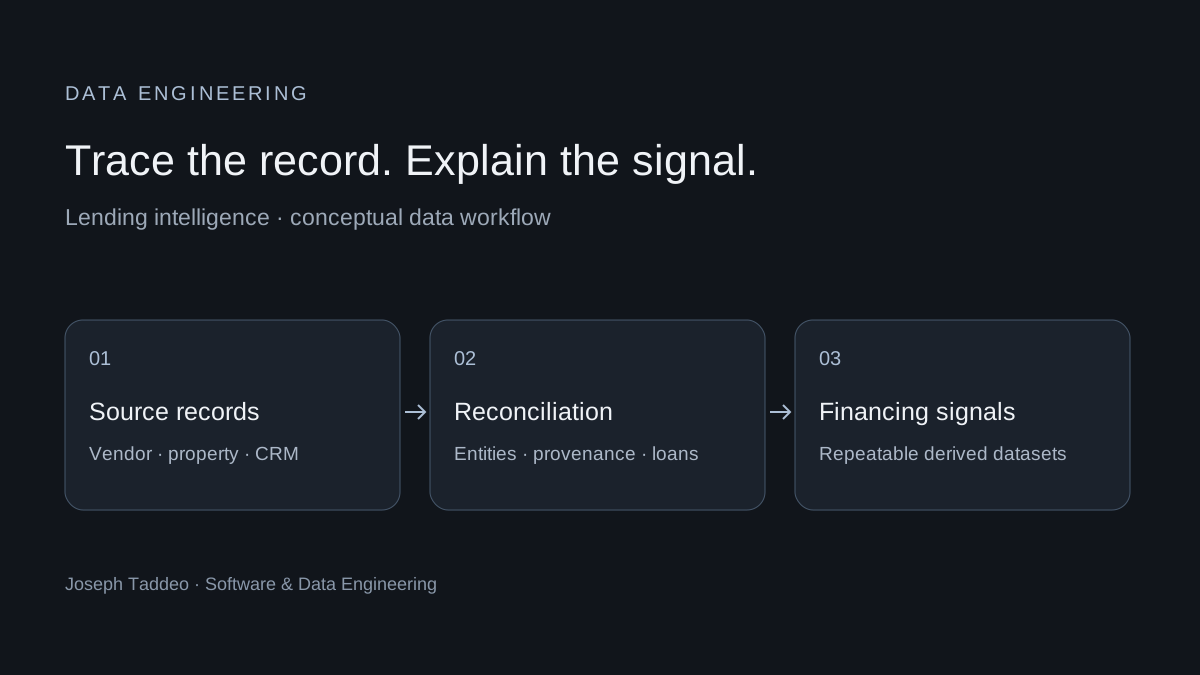
I built the processing and analytics layer across SFRA and Forecasa records, property and market information, CRM data and internal operating history. The platform processes hundreds of thousands of borrowers and turns fragmented records into borrower-fit and financing-demand signals.
What I owned
I designed canonical borrower and loan datasets, cross-source reconciliation and mortgage reconstruction. Field-level provenance, entity resolution and repeatable data rebuilds.
The unified loan record keeps source provenance at field level, while corroborated relationships govern cross-source rules. Derived datasets are rebuilt through a declared ten-stage registry with a build manifest, making dependencies and stale work explicit.
A concrete data-quality decision
Vendor status labels had been treated as loan-closure evidence. I replaced label-only closure logic with reconstruction based on transaction evidence and corroborated relationships, correcting over 100,000 loan-status records used for targeting.
The correction changes how records are interpreted downstream. Instead of treating a provider label as the final answer, borrower lists use the reconstruction rules and supporting transaction evidence.
The tradeoff
Cross-source reconciliation adds complexity compared with passing through vendor labels. It also makes disagreements visible and gives derived records a traceable basis. A repeatable rebuild can reproduce the rules applied; it cannot make incomplete external data complete.
I kept provenance and reconstruction separate from causal attribution. Linking historical records and touchpoints helps explain a deal’s path, but does not establish that a campaign caused the outcome.
What it enabled
The resulting datasets support borrower targeting, maturity analysis and operating visibility. Users get financing context they can act on; the engineering layer retains the relationships and source evidence needed to investigate discrepancies and rebuild downstream outputs.